
What are the seven Beyond Nen techniques?
Ten, Ryu, Shu, Ken, Ko, Zetsu, and Gyo. The public letters are S for Ten and Ryu, A for Shu and Ken, and B for Ko, Zetsu, and Gyo. A ranking pass orders them Ten, Ryu, Shu, Ken, Ko, Zetsu, Gyo from the top.

Beyond Nen techniques on Place 6016716328: Ten, Ryu, Shu, Ken, Ko, Zetsu, and Gyo with recap numbers, Ryu stance trades, and the Zetsu and Gyo answer.
Ten through Gyo, with the public recap numbers.
~13 min read
Beyond Nen techniques are Ten, Ryu, Shu, Ken, Ko, Zetsu, and Gyo on Place 6016716328 (Beyond Nen). A ranking pass reads them from the bottom as Gyo, Zetsu, Ko, Ken, Shu, Ryu, then Ten. The percentages in the table are the public recap of those seven. Checked November 8, 2026.
The listing has been live since November 6, 2026. The E wheel and the Nen technique list open after Rohan, on how to get Nen. Affinity trees stay on Nen affinities. Hatsu names stay on Nen abilities. Play on Roblox.
| Technique | Role | Tier | Recap numbers |
|---|---|---|---|
| Ten | All-rounder | S | +15% Strength, +16% Stamina, +10% Durability |
| Ryu | Stance switch | S | Strength: +35% Strength, +22% Stamina, −15% Durability. Defense: +35% Durability, −15% Strength, −22% Stamina |
| Shu | Weapon damage | A | +40% weapon damage |
| Ken | Defense | A | +5% Strength, +11% Stamina, +20% Durability |
| Ko | Burst | B | +50% Strength, −80% Durability |
| Zetsu | Stealth | B | Hidden from players who are not using Gyo |
| Gyo | Detection | B | See Zetsu users and items covered in Nen |
Matched by build plan, shared topics, and guide progression — not random related links.
Beyond Nen techniques are closed on a fresh Whale Island character. The path that opens Nen is the Hunter Exam, the librarian, Rohan, and a Meditation Mat. When that quest is done, E opens the technique wheel and G charges Nen. M opens the skill tree. One clear of that tree walks from Nen skills back to a tab it calls Nen technique, and the names sitting on that tab in the clear are Zetsu and Ken. The line under them is a requirement, and the experience it asks for is meditation experience from the same mat you already used for Rohan.
The clear does not read a point price, a cooldown, or a key that equips Ten by itself. Treat every empty cost cell as TBA. Combat styles sit on a neighboring tab in that same clear, and the narrator treats them as optional while skill points are scarce. Buying a combat style does not apply Ten. Filling the mat for Rohan the first time does not finish every technique node. You place the mat again when a node still wants meditation experience. The two S rows, and why a pass ranks Ten over Ryu inside that letter, are next.
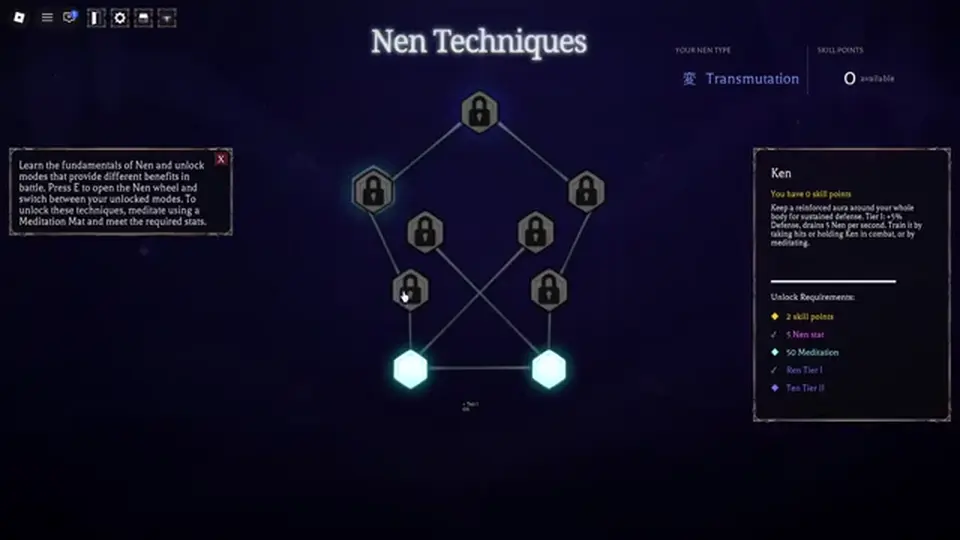
E is the wheel you open in a fight once a technique exists. The skill tree is where the node is bought. A wheel that highlights one name is the reason this page compares them as the technique you run, and a second technique staying applied in the background is unstated. If your client later shows two active rows, trust the client. Until then, pick the row whose numbers match the next thirty seconds of the fight.
The spoken requirement is experience, earned by meditating. It is the same method as the first 10/10 bar on how to get Nen. Affinity nodes can ask for mastery ranks and skill points. That bill is a different tab. Read the line on the technique node before you drain the mat into a mastery you meant to save for an affinity neighbor.
Ten is the all-rounder and the name a ranking pass puts first among Beyond Nen techniques. The recap numbers are +15% Strength, +16% Stamina, and +10% Durability. Nothing in that row is a penalty. The same pass calls it the safer choice for almost any build, because you can push damage and still take a hit if the exchange flips. Ken is the row it names when you specifically need more Durability. For a fight you have not scouted, Ten is the keep.
Ryu is the other S, and that pass ranks it just under Ten. It is a stance switch, not a single buff. Strength stance is +35% Strength, +22% Stamina, and −15% Durability. Defense stance is +35% Durability, −15% Strength, and −22% Stamina. Strength is the stance for a pace you are dictating: more damage than Ten, and a smaller Durability hole than Ko. Defense is the stance for weather. If you still need to win the trade or keep a chase, the Strength and Stamina penalties are why the pass sends you back to Ten. Shu and Ken are the A pair, and they win when the job is the weapon or the extra Durability.

| Run | Strength | Stamina | Durability | Use it when |
|---|---|---|---|---|
| Ten | +15% | +16% | +10% | The fight has no plan yet |
| Ryu Strength | +35% | +22% | −15% | You are dictating the pace |
| Ryu Defense | −15% | −22% | +35% | You need to weather pressure |
The letter on both rows is S. The order inside the letter is the pass: Ten, then Ryu. Ryu’s Strength stance is a bigger damage push, and it asks you to pick the stance on purpose. Ten asks you to leave it on. If you forget which stance Ryu is in, you are playing the penalties. That is the practical reason the safer default sits above the more flexible one.
Ryu’s Defense stance is +35% Durability. Ken is +20% Durability and still adds Strength and Stamina. The larger shield is the stance, and the price is printed on the same row: −15% Strength and −22% Stamina. Swap back to Strength, or to Ten, when the pressure ends. Sitting in Defense through your own combo is how the stance spends the damage you switched to it to protect.
Shu is weapon damage, A on the recap, and the ranking pass puts it above Ken inside that letter. The number is +40% weapon damage, and a clear of the pass says that 40% out loud. The bonus is weapon damage. A build whose hits are Nen skills or a Hatsu is the build the pass sends back to Ten’s spread. A weapon account is the build that can treat Shu as the technique it actually runs. Races is where Rabbit’s weapon passive lives. This page does not multiply those two bonuses into a third number.
Ken is the defense A. The recap is +5% Strength, +11% Stamina, and +20% Durability. The ranking pass describes that Durability line as twice Ten’s Durability bonus, which matches +20% against Ten’s +10%, and it still calls the Strength and Stamina “extra.” Ken is the close-range keep when you are losing the trade and you refuse Ryu’s penalties. It is a smaller shield than Ryu Defense and a cleaner stat line. The next section is the B row that spends the shield on purpose.
| Technique | What the recap adds | What it leaves alone | Pick it over Ten when |
|---|---|---|---|
| Shu | +40% weapon damage | Strength, Stamina, Durability, Nen skills, Hatsu | The weapon string is most of your damage |
| Ken | +5% Strength, +11% Stamina, +20% Durability | No penalty line | You are losing close trades and want Ten’s shape with a thicker Durability bonus |
The written cell says weapon damage. Godspeed, Jajanken, and the rest of the ability table are Nen kits. If those names are doing the damage, Shu’s 40% is the wrong lever. Ten’s Strength, Stamina, and Durability still apply to the body that is casting them. Read the ability page for parry and cooldown. The technique row will not tell you whether Skull Breaker can be parried.
Twice Ten’s Durability bonus is the sentence to remember, and the other two stats stay positive. You give up Ten’s larger Strength and Stamina (+15% and +16% against Ken’s +5% and +11%) to buy the extra Durability. That trade is the whole A. If the fight is already safe, Ten’s Strength line is the one the pass would rather you keep.
Ko is the burst B. The recap is +50% Strength and −80% Durability. The ranking pass calls the damage a punish you use when you already know the swing will land, and it calls a miss a vulnerable character. Ryu’s Strength stance is the comparison it draws: you give up some of Ko’s burst, and you can afford to be hit back, because the Durability penalty there is −15% rather than −80%.
Save Ko for an opening you can finish. A blocked punish on −80% Durability hands the other player the better turn. Ten and Ken exist so the rest of the fight has a body left. The ranking pass places Ko at the top of B, above Zetsu and Gyo, because the damage is real when the read is real. The letter stays B because the hole is the largest number on this page. Zetsu and Gyo, which do their work before the trade, are next.
| Burst option | Strength | Durability | Bring it out when |
|---|---|---|---|
| Ko | +50% | −80% | The punish is one you will land |
| Ryu Strength | +35% | −15% | You want a damage push and you might get hit |
| Ten | +15% | +10% | You are not sure the swing is clean |
The pass does not print a cooldown for Ko. It prints the consequence of being wrong. If you cannot see the punish yet, you are on Ten or on Ryu Strength. Switching into Ko “to try it” is the Durability hole with no swing attached. Put it on for the hit, then leave it.
Ko’s +50% is Strength. Shu’s +40% is weapon damage. They are different cells. A weapon account that wants the safer damage line stays on Shu. A Strength punish stays on Ko for that one swing. This page has no tested formula that stacks them, so it will not invent one.
Zetsu is stealth, B. The recap says you are hidden from players who are not using Gyo. The ranking pass says you hide your presence, sneak past, and choose when the fight starts. It also says the row does little once the fighting has started. That is a positioning tool. The moment someone knows where you are, Ten or Ken is the technique for the exchange.
Gyo is detection, B, and that pass ranks it last. It spots players hiding with Zetsu and finds items covered in Nen. In a fight against someone you can already see, the pass wants a stat row instead. Bring Gyo out for the search, then leave it. The same pass says Gyo and Nen can still reveal a Zetsu user. A written line of the same evaluation uses the word En for that clause. The seven-name table on this page does not gain an eighth row from either sentence.
| Technique | Recap job | What the pass adds | Put it away when |
|---|---|---|---|
| Zetsu | Hidden from players not using Gyo | Sneak, and choose the first hit. Little help after the fight starts | They have seen you, or you are already trading |
| Gyo | See Zetsu users and Nen-covered items | Ranked last for combat bonuses | You can already see the person you are fighting |
If opponents keep leaving your screen, Gyo is the row that the recap names as the counter. Standing in Ten while they reposition is how you lose the first hit. You do not live in Gyo. You use it to end the hide, then you take Ten, Ryu, Shu, or Ken for the hits that follow.
Hunters who know the source material will hear En in that sentence. The menu this clear shows, and the seven names this recap ranks, are Ten, Ryu, Shu, Ken, Ko, Zetsu, and Gyo. If a later patch prints En on the Nen technique tab, add it then. Until the tab shows it, the reveal tools you can plan around are Gyo and whatever the pass meant by Nen.
Match the next thirty seconds, then the build. Ten covers the unscanned fight. Ryu covers a stance you will actually switch. Shu covers a weapon string. Ken covers a close trade you are losing. Ko covers one punish. Zetsu covers the approach. Gyo covers the search. The tier list repeats these letters next to affinities, races, and lineages. This page is only the seven techniques.
The footer Next opens the type that decides whether Shu or Ten is even the right family, and the race that decides whether a weapon passive is already on the character. The FAQ holds the short forms: the seven names, Ten as the default, Ryu’s two lines, Ko’s hole, and the Zetsu answer.
| Your next thirty seconds | Run | Leave it when |
|---|---|---|
| You have not scouted the fight | Ten | You have a weapon string or a Durability problem |
| You are setting the pace | Ryu Strength | You start getting hit more than you hit |
| You are weathering | Ryu Defense | You need Strength or Stamina back |
| The weapon is the damage | Shu | The Hatsu is the damage |
| Close trades are going against you | Ken | You are safe and want Ten’s Strength line |
| One punish will land | Ko | The swing is a guess |
| You want the first hit unseen | Zetsu | They can see you |
| Someone dropped off your screen | Gyo | You have found them |
Enhancement and Transmutation are the melee and burst types on Nen affinities. They do not apply Ten for you. A Specialist with no innate buff feels Ko’s Durability hole more, because the type did not hand over a defense line. Read the type, then pick the technique. The neighbor cap of 8 is a skill-tree problem. It is not a technique percentage.
A patch can move +40% or −80%. When the node, the wheel, or a later clear prints a different figure, that figure is the one you are playing. This table is the public snapshot from the check date in the lead. Empty costs stay empty on purpose.
Next: read the type on Nen affinities so you know whether the damage is a weapon string (Shu) or a Hatsu (Ten, Ken, or a stance).
Race passives that sit under these percents are on races. Unlock order stays on how to get Nen. The cross-system letters are the tier list.
Ten, Ryu, Shu, Ken, Ko, Zetsu, and Gyo. The public letters are S for Ten and Ryu, A for Shu and Ken, and B for Ko, Zetsu, and Gyo. A ranking pass orders them Ten, Ryu, Shu, Ken, Ko, Zetsu, Gyo from the top.
Ten. The recap is +15% Strength, +16% Stamina, and +10% Durability, with no penalty. Use it when you have not scouted the fight. Switch off it when the job is a weapon, a stance, a punish, a hide, or a search.
Strength stance: +35% Strength, +22% Stamina, −15% Durability. Defense stance: +35% Durability, −15% Strength, −22% Stamina. Defense is tankier than Ken and it charges you Strength and Stamina for the shield.
+50% Strength and −80% Durability. The ranking pass wants it on a punish you will land. Ryu Strength is the burst that still lets you get hit.
Gyo. Zetsu hides you from players who are not using Gyo, and Gyo also shows items covered in Nen. One pass adds that Nen can reveal you. A written line says En. En is not an eighth technique on this table.
No. They show up after Nen does: Hunter Exam, Rohan, Meditation Mat. One clear of the Nen technique tab shows Zetsu and Ken behind a meditation-experience requirement. Exact costs stay TBA.
The recap cell says +40% weapon damage. Nen skills and Hatsu are a different bucket. If the ability is doing the damage, Ten’s spread is the row the ranking pass prefers.
Matched by build plan, shared topics, and guide progression — not random related links.